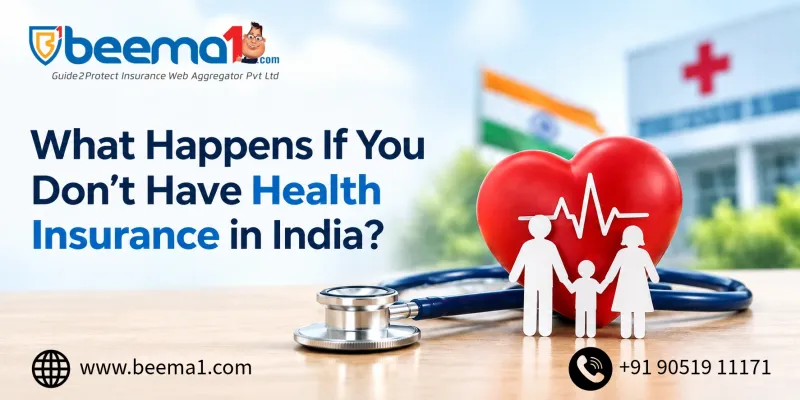
What Happens If You Don’t Have Health Insurance in India?
What Happens If You Don’t Have Health Insurance in India? | Beema1
What Happens If You Don’t Have Health Insurance in India?
If you do not have health insurance in India, you are responsible for paying all eligible medical, diagnostic, and hospitalisation expenses directly from your own personal funds. Without a policy in place, there is no third party to share the financial impact of a planned treatment or an emergency admission, meaning your bank savings, current earnings, or investments must absorb the entire bill.
Medical treatments in India have advanced significantly over the past two decades, offering access to world-class clinical care, specialised surgeries, and advanced diagnostic infrastructure. At the same time, the cost of accessing quality private healthcare has grown substantially. While many Indian households maintain disciplined savings habits—regularly putting money into fixed deposits, mutual funds, gold, or public provident funds—savings alone serve a very different purpose than dedicated risk protection.
When a family member falls ill unexpectedly, a medical bill arrives on its own schedule. It does not wait for a fixed deposit to mature or for equity markets to be at a high. Without health insurance, even individuals with sound financial habits can find their monthly budgets severely disrupted by an unforeseen medical event. Understanding the practical realities of managing healthcare costs without coverage is essential for planning long-term financial stability.
What Happens If You Don’t Have Health Insurance?
Without health insurance, the direct consequence is straightforward: you become entirely self-insured. Every expense incurred during medical consultation, diagnostic testing, pharmacy visits, emergency room care, and inpatient hospitalisation must be paid using personal cash flow or accumulated assets.
In day-to-day life, the absence of a policy may go unnoticed as long as everyone in the family stays healthy. However, healthcare needs are inherently unpredictable. When a sudden illness, accidental injury, or chronic diagnosis develops, the practical implications quickly emerge across multiple areas of household finance.
You Pay Medical Expenses From Your Own Pocket
Day-to-day healthcare in India largely consists of out-of-pocket medical expenses. When you visit a general physician, consult a specialist, undergo blood tests, or purchase prescribed medicines for seasonal illnesses, these costs are typically handled directly from your monthly cash flow.
However, when an illness requires active clinical intervention, out-of-pocket expenses escalate rapidly. Consider a common condition like severe dengue or viral pneumonia requiring a four-to-five-day hospital admission. Even in a modest private nursing home, the final bill includes:
- Room nursing charges
- Specialist visit fees
- Intravenous medications and fluids
- Daily blood investigations and monitoring
- Consumables and administrative charges
Without an active health insurance policy, every single line item on that discharge summary must be settled out of pocket before the hospital issues a discharge clearance.
A Major Hospital Bill Can Affect Your Savings
A substantial hospital bill rarely affects only the present month’s household budget. In most cases, it cuts deeply into funds carefully set aside for future objectives.
Indian families typically save with clear milestones in mind: building an emergency contingency reserve, saving for a child's school or university admission, prepaying a home loan, or accumulating a retirement nest egg. When an acute health episode requires an immediate outlay of several lakhs of rupees, those savings are often the first source tapped. Diverting funds from long-term investments to settle a hospital invoice can set back your financial roadmap by several years, requiring you to rebuild your reserves from scratch.
Emergency Hospitalisation Can Create Financial Pressure
Medical emergencies bring immediate emotional stress, leaving little time or mental bandwidth to make calm, calculated financial decisions. If an emergency admission occurs late at night or during a weekend, the immediate priority is securing immediate clinical care for your loved one.
Hospitals typically ask for an initial financial deposit at the time of admission to initiate non-emergency procedures or assign inpatient rooms. When you do not have access to a cashless health insurance network, arranging this upfront deposit requires immediate liquidity. Sourcing liquid cash on short notice—especially outside regular banking hours—adds severe practical friction to an already stressful personal situation.
Family Members May Have to Bear the Financial Burden
In the Indian social structure, healthcare emergencies are rarely borne by an individual alone; they are collective family events. When a person without coverage requires prolonged medical care, the financial responsibility frequently expands to include working children, parents, siblings, or extended relatives.
If one family member exhausts their available bank balance during treatment, other relatives often step in to cover pharmacy bills, post-discharge medical equipment, home nursing, or follow-up consultations. While family solidarity is a core strength of Indian households, sudden and repeated financial calls can place immense strain on the broader family unit's financial health.
You May Have Fewer Financial Options During a Medical Emergency
When personal bank balances fall short of a large hospital bill, individuals without insurance often face difficult secondary choices. These can include:
- Breaking long-term fixed deposits before maturity, incurring penalty charges.
- Selling mutual fund units or stocks during a market downturn, locking in capital losses.
- Liquidating family physical gold or ancestral assets.
- Taking high-interest personal loans or emergency credit card cash advances.
- Borrowing funds informally from friends, colleagues, or local money lenders.
None of these avenues are guaranteed, and many carry long-term financial consequences that outlive the medical recovery itself. Having insurance does not eliminate the illness, but it provides a dedicated financial cushion designed specifically to handle eligible hospital costs.
How Expensive Can Healthcare Be in India?
Healthcare expenses in India vary widely and depend on several overlapping factors. There is no single standard price for medical procedures across the country, which makes budgeting for healthcare independently challenging.
The primary variables that determine treatment costs include:
- Location and Tier of City: Medical care in Tier-1 metropolitan cities (such as Mumbai, Delhi NCR, Bengaluru, and Chennai) generally commands higher operational overheads, room rents, and specialist consultation rates than in Tier-2 or Tier-3 towns.
- Type of Healthcare Facility: Treatment at a charitable hospital or a small community nursing home differs significantly in price compared to a multi-specialty, tertiary-care corporate hospital with robotic surgery capabilities and advanced intensive care units (ICUs).
- Clinical Speciality and Condition: Complex procedures involving cardiology, oncology, neurology, or orthopaedics require advanced medical technology, expensive implants, and specialised surgical teams, making them substantially more costly than routine medical management.
- Duration of Stay and Room Category: In many private hospitals, charges for doctor visits, nursing, and even certain surgical procedures are pegged to the category of room chosen (e.g., general ward, twin sharing, single private, or deluxe suite). A longer stay in an ICU naturally increases overall costs due to round-the-clock monitoring and respiratory or organ support.
- Post-Operative Care and Diagnostics: Modern treatment protocols rely heavily on pre-admission investigations (such as MRIs, CT scans, and molecular pathology) and post-discharge rehabilitation, both of which add to the total cost of recovery.
Because healthcare expenses depend heavily on individual clinical needs, attempting to fund severe medical events entirely through routine savings exposes an individual to open-ended financial risk.
Health Insurance vs Paying Medical Expenses Yourself
To understand the practical differences between self-funding healthcare and using an insurance policy, review the following comparison:
| Factor | Without Health Insurance | With Suitable Health Insurance |
|---|---|---|
| Hospitalisation Expenses | Paid entirely from personal savings, cash, or loans. | Eligible inpatient expenses are borne by the insurer according to policy terms. |
| Financial Planning Impact | Large medical bills can erode emergency reserves and long-term investments. | Helps protect planned savings by transferring covered medical risks to the insurer. |
| Cashless Treatment Facility | Unavailable; all payments must be made upfront directly to the hospital. | Available at empanelled network hospitals, subject to policy approvals and terms. |
| Out-of-Pocket Expense Level | 100% of all hospital, diagnostic, and pharmacy costs must be self-funded. | Limited primarily to deductibles, co-pays, non-medical items, and costs exceeding policy sub-limits. |
| Ongoing Cost | No regular payments required during healthy periods. | Requires periodic payment of a fixed health insurance premium. |
| Coverage Limitations | No restrictions, but constrained entirely by your own net worth and liquidity. | Defined by the chosen sum insured, room-rent limits, specific disease sub-limits, and exclusions. |
| Waiting Periods | None applicable; you spend personal money immediately as needed. | Applicable for specific illnesses, pre-existing conditions, and initial policy durations. |
| Claim Formalities | None; all transactions remain purely between you and the hospital billing desk. | Requires timely intimation, submission of medical records, and adherence to claim procedures. |
Note: Health insurance policies do not automatically cover every single expense. Every contract contains specific non-payable items, co-payments, deductibles, room-rent capping, and exclusions detailed in the policy wording.
What Are the Financial Risks of Not Having Health Insurance?
Opting out of health insurance carries distinct, cumulative financial risks that can affect household balance sheets:
Unplanned Medical Emergency
         │
         ▼
Depletion of Liquid Emergency Reserves
         │
         ▼
Premature Liquidation of Investments (Fixed Deposits / Mutual Funds)
         │
         ▼
Recourse to High-Interest Debt or Family Assistance
         │
         ▼
Compromised Long-Term Financial Goals (Retirement / Education)
- Premature Depletion of Emergency Funds: An emergency fund is designed to cover essential living costs during temporary income disruption or job transition. Absorbing a major clinical episode can wipe out this fund immediately, leaving the household vulnerable to subsequent non-medical emergencies.
- Forced Sale of Appreciating Investments: Liquidating mutual fund equity holdings, equity shares, or sovereign gold bonds during an emergency forces you to accept the prevailing market price, potentially crystallising capital losses or sacrificing future compound growth.
- High-Cost Debt Accumulation: When institutional savings fall short, individuals may rely on unsecured personal loans or revolving credit card balances. These instruments carry high interest rates that can lead to prolonged debt-servicing cycles long after physical recovery.
- Postponement of Family Milestones: Major life goals—such as funding higher education, purchasing a primary home, or starting a business venture—often have to be postponed or scaled down to accommodate the financial aftermath of an unhedged illness.
- Vulnerability to Recurring Health Issues: Chronic ailments (such as kidney disease requiring regular dialysis or cardiac conditions requiring sequential interventions) involve recurring medical expenses. Self-funding repeated treatments places unrelenting, long-term strain on regular cash flows.
- Loss of Treatment Discretion: When finances are constrained, patients and their families may feel compelled to make clinical choices based purely on immediate affordability rather than optimal medical outcomes, such as delaying elective surgeries or choosing less equipped facilities.
What If You Buy Health Insurance After a Medical Problem?
A frequent misconception is that one can simply wait until an illness appears and then immediately purchase a health insurance policy to pay for the hospital bill. In practice, health insurance is an instrument designed to protect against unforeseen future events, not to cover financial events that are already underway.
Purchasing a policy after developing a medical condition involves several regulatory and underwriting considerations:
Pre-Existing Diseases (PED)
IRDAI describes a pre-existing disease using a 36-month lookback before policy commencement for a physician's diagnosis or recommended or received medical advice or treatment. This lookback identifies a pre-existing condition; it is separate from the waiting period after cover begins. Check the policy's applicable waiting period and disclose your medical history accurately.
Waiting Periods
Health insurance contracts incorporate mandatory waiting periods:
- Initial Waiting Period: Most policies mandate a initial 30-day waiting period from the policy inception date, during which no claims are admissible except those arising from accidental injuries.
- Specific Disease Waiting Period: Treatments for common conditions like cataracts, hernias, kidney stones, and joint replacements typically carry a waiting period of one to two years, irrespective of whether they were previously diagnosed.
- Pre-Existing Disease Waiting Period: Covered conditions declared at the time of proposal are subject to a waiting period—commonly between one to three years, depending on policy terms—before expenses related to those conditions become admissible.
Underwriting and Full Disclosure
When you apply for a health insurance policy, underwriters assess the risk based on your medical history, age, family health background, and lifestyle habits. Depending on the assessment, the insurer may:
- Accept the proposal at standard premium rates.
- Apply a premium loading (an increased premium to account for higher health risk).
- Introduce a permanent co-payment or specific condition sub-limit.
- Exclude specific pre-existing health complications permanently, subject to regulatory norms.
- Decline the proposal altogether if the existing health profile falls outside their underwriting guidelines.
Complete and honest disclosure of your medical history on the proposal form is critical. Non-disclosure or concealment of past medical conditions can lead to claim rejections or policy cancellation during a hospitalisation event. Coverage, exclusions, waiting periods, claim conditions, and benefits vary between health insurance policies. Always read the policy wording and terms before purchasing.
Is Health Insurance Necessary for Everyone in India?
While personal circumstances, financial liquidity, and risk appetites differ, having a structured health insurance plan is a relevant consideration for nearly every life stage in India.
Young Working Professionals
Younger individuals often feel health insurance is unnecessary because their immediate risk of hospitalisation is low. However, securing a policy early offers two concrete advantages: lower premium rates and the ability to serve mandatory waiting periods comfortably while remaining healthy. Cover for accidental injuries and acute infections depends on the policy. An accident exception may apply to an initial illness waiting period; acute infections are not automatically covered from the first day. Check the waiting periods, exclusions and claim conditions in the policy wording.
Families with Growing Children
A family health insurance policy (often structured as a family floater) covers spouses and dependent children under a shared sum insured. Children are frequently susceptible to seasonal infections, respiratory problems, and accidental injuries that require emergency clinical attention. A family floater provides a single pool of coverage to absorb these costs without requiring individual policies for each member.
Dependent Parents and Senior Citizens
As individuals age, the likelihood of developing lifestyle illnesses, degenerative joint issues, and cardiovascular concerns increases substantially. Senior citizens require frequent medical consultations, diagnostic monitoring, and occasional hospitalisation. Securing dedicated senior citizen coverage or maintaining adequate individual sum insured levels helps protect their retirement corpus from being eroded by regular hospital visits.
Self-Employed Individuals and Gig Workers
Salaried employees often receive basic group health insurance from their employers. Freelancers, business owners, independent consultants, and gig economy workers do not have access to corporate safety nets. For this segment, individual or family health insurance is an essential buffer to protect operational business capital and personal savings from being consumed by a healthcare crisis.
The Limits of Employer-Provided Health Cover
Relying solely on corporate group health insurance carries distinct limitations:
- Employment Dependency: Ask your employer to confirm the group cover end date when you change jobs, face a layoff or retire. Arrange any replacement cover before the existing cover ends.
- Standardised Sum Insured: Corporate policies often offer basic limits (e.g., ₹2 lakh to ₹5 lakh) that may prove inadequate for complex tertiary treatments in major private hospitals.
- Restrictive Clauses: Many group covers incorporate mandatory room-rent ceilings, corporate co-pays, or specific sub-limits.
Understanding your existing employer cover allows you to assess whether a personal retail health policy or a top-up plan is needed to address potential gaps.
What Should You Check Before Buying Health Insurance?
Selecting a health insurance policy requires looking beyond the marketing brochure and carefully assessing specific terms and conditions:
- Sum Insured: Ensure the total coverage amount is adequate for the healthcare costs in the city where you reside and receive treatment.
- Premium Affordability: The premium should fit comfortably within your ongoing household budget so that you can renew the policy year after year without lapse.
- Room-Rent Limits: Check whether the policy imposes a monetary cap or specific category restriction on hospital room rent (e.g., 1% of sum insured per day or single private room eligibility). Exceeding this limit often leads to proportionate deductions across the entire hospital bill.
- Pre-Existing Disease (PED) Waiting Period: Check how many months or years you must hold the policy before declared chronic conditions become eligible for claims.
- Co-Payment and Deductibles: Verify whether you are required to pay a mandatory percentage of every claim (co-pay) or settle an initial threshold out of pocket (deductible) before the insurer pays.
- Cashless Network Hospitals: Confirm that reputable hospitals and medical centres in your local vicinity are part of the insurance company's active network list.
- Permanent Exclusions: Read the list of expenses that the policy does not cover under any circumstances, such as cosmetic procedures, experimental therapies, or non-medical consumables.
- Restoration / Reinstatement Benefits: Check whether the policy automatically replenishes the sum insured if it is exhausted by previous claims within the same policy year.
- Cumulative Bonus (No-Claim Bonus): Check whether the policy offers a claim-free bonus, its limits and its effect on cover or renewal cost. A bonus does not freeze future premiums.
- Policy Renewal Terms: Check renewal conditions, premium due dates and continuity benefits. Keep premiums current; renewability does not mean every future expense will be covered or that premiums remain unchanged.
How Can Health Insurance Help With Financial Planning?
Health insurance should be viewed strictly as a risk-management instrument, not as an investment or wealth-creation product. It does not generate financial returns, nor does it guarantee absolute financial immunity.
Its fundamental role in personal finance is risk transfer:
Financial Risk of Healthcare -> Insurance Premium -> Transferred to Insurer (Up to Sum Insured)
By paying a predictable, budgeted premium at regular intervals, you transfer the potential liability of large, unpredictable hospital bills to the insurance company, within the boundaries of the contract. This structure prevents unplanned medical events from forcing premature asset liquidation, disturbing regular systematic investment plans (SIPs), or exhausting liquid bank balances.
Integrating a suitable health insurance policy into your broader financial plan ensures that your savings remain dedicated to the life goals for which they were originally intended.
Final Takeaway
What happens if you don’t have health insurance in India? In practical terms, all eligible healthcare and hospitalisation expenses must be funded entirely from your personal savings, earnings, or borrowed resources. A sudden medical emergency can quickly deplete emergency funds, disrupt long-term investment goals, and place immediate financial strain on your extended family.
A suitable health insurance policy helps transfer covered hospitalisation costs to an insurer, subject to defined terms, exclusions, limits, waiting periods, and conditions. Before choosing a health insurance policy, compare coverage, exclusions, waiting periods, network hospitals, and costs carefully. Beema1.com can help you understand and compare available health insurance options to make informed decisions for yourself and your family.
Frequently Asked Questions About Health Insurance in India
FAQ 1
What happens if I don't have health insurance in India?
If you do not have health insurance, you must pay all hospitalisation, diagnostic, surgical, and post-treatment expenses entirely from your personal funds. A major medical event can deplete emergency savings, force the early liquidation of long-term investments, or require you to borrow money, creating immediate financial stress for your family.
FAQ 2
Can I manage hospital expenses in India without health insurance?
You can manage hospital expenses without insurance if you maintain substantial, liquid personal savings or an emergency fund large enough to absorb significant medical bills. However, self-funding leaves your accumulated savings exposed to medical inflation and high hospital costs, which could otherwise be mitigated through a dedicated insurance policy.
FAQ 3
Is health insurance necessary if I already have corporate coverage from my employer?
Corporate health coverage can help, but its limits, co-payments and end date depend on the group policy. Confirm with your employer when cover ends after a job change or retirement. A separately maintained personal policy can reduce a gap in cover, subject to timely renewal and its terms.
FAQ 4
What happens if I buy health insurance after getting diagnosed with an illness?
An existing diagnosis may fall within the PED definition. Cover depends on the accepted policy terms and any applicable waiting period, which can be up to 36 months under current health-insurance rules. Check accepted waivers and continuity credits; an application does not guarantee cover for an existing illness.
FAQ 5
Does health insurance cover all medical expenses during hospitalisation?
No, health insurance does not cover every expense automatically. Policies generally cover eligible inpatient medical treatments subject to the sum insured, room-rent ceilings, and disease-specific sub-limits. Non-medical consumables (such as administrative fees, gloves, and specific disposable items), co-payments, and treatments explicitly listed under policy exclusions must be settled out of pocket.
Follow Us On Facebook and Instagram for Daily Updates.
Sources and policy checks
For the current regulatory explanations, see IRDAI health insurance FAQs. Check your insurer's policy wording, schedule and customer information sheet for the cover and conditions that apply to you.
An example of plan-specific waiting periods, consumables and restoration conditions is available in HDFC ERGO policy wording; these example benefits should not be assumed to apply to other plans.
Ready to look at cover? See health insurance →